




Chapter overview
With wall lights, the result often depends more on their position than on the design of the fitting itself. The same model can look calm and architectural in the right place, yet appear unbalanced just a few centimetres higher, lower or too close to a corner.
In modern, reduced interiors, it therefore makes sense to plan wall lights as part of the room rather than adding them at the end as decoration. They can structure walls, emphasise circulation routes, create indirect light and add a second layer of light alongside ceiling lighting.
If you would like to browse suitable models straight away, see our selection of indoor wall lights. This guide deliberately starts with the question of how wall lights should be used.

1. Define the lighting effect first – not the mounting height
The most common question is: How high should a wall light be mounted? A better question comes first: What should the light achieve at this point?
An up-down wall light, an indirectly emitting fitting and a directional reading light perform very different tasks. The appropriate mounting height follows from that function.
Up-down light
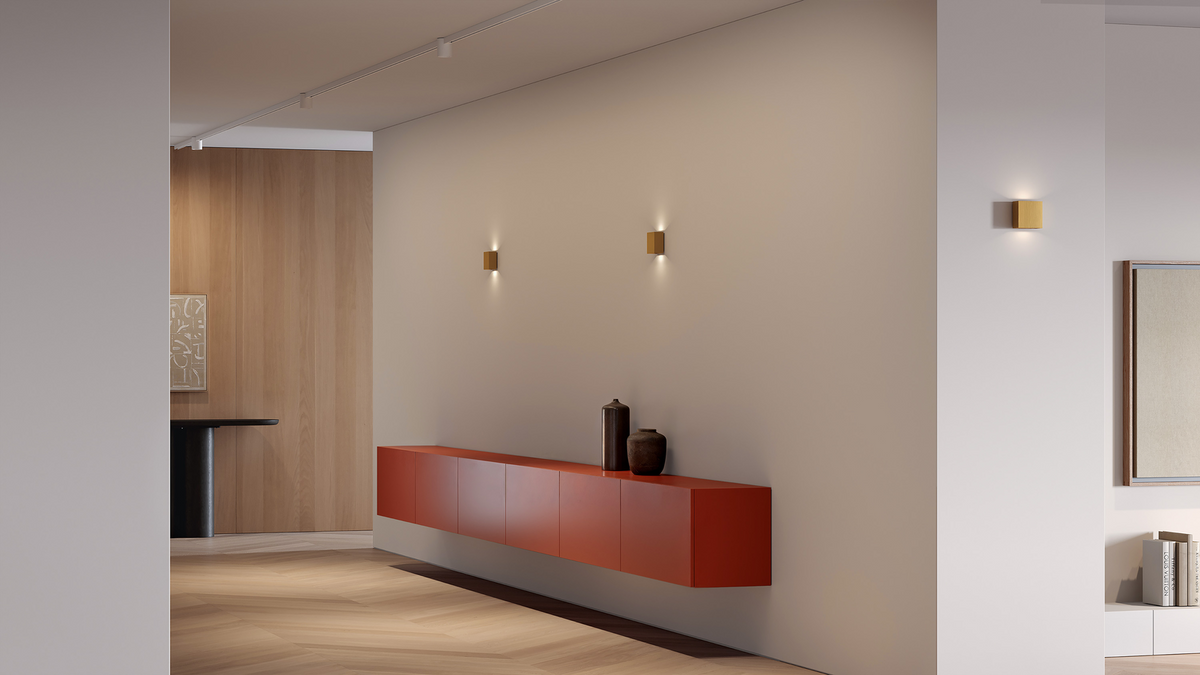
Lights that emit upwards and downwards create a defined pattern on the wall. They work particularly well for structuring long wall surfaces or creating a repeated rhythm of light along a hallway. The closer the fitting sits to the ceiling or floor, the more the visible light pattern changes.
Indirect light
With indirectly emitting wall lights, the illuminated wall rather than the fitting itself becomes the focus. The result is softer and calmer. This can be especially pleasant in living rooms and bedrooms because it reduces hard contrasts.
Directional light
If a wall light is intended to illuminate a picture, shelf, seating area or another specific zone, its position becomes more functional. The direction should follow the actual use of the room rather than a generic standard height.

2. What mounting height makes sense for wall lights?
There is no single universally correct height. Ceiling height, furniture, viewing direction, light distribution and the size of the fitting all interact.
For decorative or indirectly emitting wall lights in typical living spaces, a position of around 1.50 to 1.80 metres above finished floor level is often a useful starting point. It is not a fixed rule, only a planning reference.
The main aim is to avoid uncomfortable glare in the normal field of view and to give the light pattern enough room on the wall. A higher mounting position can make sense in very tall rooms, while the same height can already feel too high in a low room.
Important: always judge the height in the finished room
In a new build, wall outlets are often planned before furniture, mirrors, sideboards or artwork have been finalised. This is where many mistakes occur. A light above a sideboard, for example, should not be positioned according to floor height alone, but in relation to the furniture, the available wall surface and the desired lighting effect.

3. Spacing and position: symmetry is not automatically right
Two or more identical wall lights are often arranged symmetrically. This can look very calm, especially in long hallways, on large wall surfaces or in clearly structured architecture.
Spacing should still not be chosen by eye alone. With up-down lights in particular, the visible light pattern is part of the design. If the fittings are too close together, the beams overlap. If they are too far apart, dark gaps appear.
A sensible sequence is:
- define the important wall surfaces and sightlines first,
- then consider furniture, doors and artwork,
- assess the desired light pattern,
- and only then determine the final wall outlets.
With several fittings, a clear repeated rhythm usually looks more refined than a series of unrelated spacings.
4. The wall surface changes the lighting effect
Wall lights do not simply illuminate the room – above all, they illuminate the wall itself. The surface therefore has a major influence on the result.
On a smooth, pale wall, a beam appears clean and calm. Textured plaster, natural stone, exposed concrete or wallpaper create more shadow and depth. Architecturally, that can be very effective.
On strongly textured surfaces, however, grazing light can make small irregularities much more visible. Details that go unnoticed in daylight may become prominent once the wall light is switched on.

5. Wall lights in hallways
Hallways benefit particularly from wall lights because they are often narrow and can look flat when illuminated only by one central ceiling light. Repeated points of light along the wall can visually structure a long hallway while creating a pleasant ambient level.
In narrow passages, fittings should be compact and avoid projecting unnecessarily far into the space. Doors and frames should also be considered early so the light patterns are not accidentally cut off.
6. Wall lights in the living room
In a living room, wall lights are particularly useful as a second layer of light. Instead of illuminating the entire space only from the ceiling, selected wall areas can be brightened deliberately.
This works beside a sideboard, on a free wall, in a reading zone or as a repeated element through an open-plan living area. It adds depth without introducing more large fittings into the field of view.
For more ideas on combining different types of light, see our guide to living-room lighting. Suitable fittings for the whole room can be found in our living-room lighting category.
7. Wall lights in the bedroom
In the bedroom, wall lights can be atmospheric or functional. Indirect models work well for calm evening light. A bedside reading light, by contrast, should be aimed more precisely and positioned according to the actual bed and headboard.
A fixed standard height is particularly unhelpful beside a bed. A low upholstered bed needs a different position from a high box-spring bed. The wall outlet should therefore always be planned together with the actual furniture.
You can find suitable solutions for the whole room in our bedroom lighting category.

8. Surface-mounted or recessed wall light?
Alongside classic surface-mounted wall lights, recessed wall lights are another option. They create a particularly restrained look but require a suitably prepared installation. This decision should therefore be made as early as possible.
Surface-mounted fittings are more flexible and are often easier to integrate into an existing electrical plan. Recessed wall lights can merge very quietly with the architecture when the wall build-up and recess are considered from the start.
If you are looking for a particularly discreet solution, see our recessed indoor wall lights.
9. Consider colour temperature and dimming
Warm light is commonly used in living spaces. Whether 2700 K or 3000 K works better depends on the materials, wall colour and desired atmosphere. Warm woods, beige and natural tones often feel especially comfortable with very warm light, while clear, reduced interiors can appear a little more precise at 3000 K.
If wall lights are used mainly in the evening, dimming is particularly useful. A fitting that needs to provide enough light early in the evening can later be reduced considerably, allowing the same light to serve both functional and atmospheric purposes.
10. Common mistakes when planning wall lights
- Planning wall outlets without reference to furniture: the fitting later sits too high or conflicts visually with a sideboard, bed or picture.
- Focusing only on the shape of the fitting: with wall lights, the lighting effect is at least as important as the housing.
- Mounting too close to the ceiling, a corner or a door: the light pattern is cut off and loses its effect.
- Underestimating glare: visible light sources can quickly become uncomfortable at eye level.
- Combining too many different wall lights: in reduced interiors, a repeated design language usually looks calmer.
Conclusion: good wall lighting starts with the wall, not the fitting
Wall lights work best when they are considered part of the architecture. The right mounting height follows from ceiling height, furniture, viewing direction and lighting effect – not from one universal number.
If you first decide which wall should be emphasised and what kind of light pattern should appear there, choosing the right fitting becomes much easier.
Browse our selection of modern models in the indoor wall lights category.


Leave a comment
This site is protected by hCaptcha and the hCaptcha Privacy Policy and Terms of Service apply.